

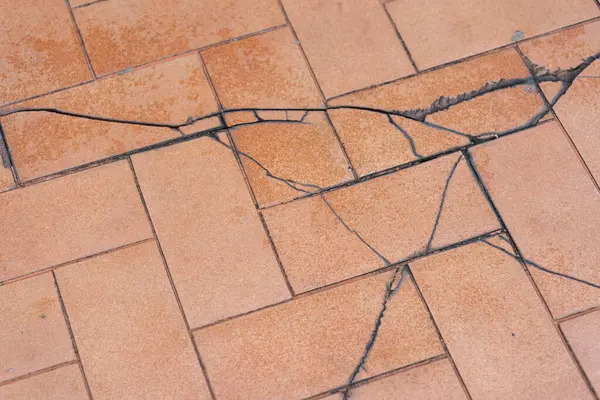
A cracked tile is almost never a tile problem. Tile and stone are among the hardest surfaces you can put on a floor, so when one splits, the force usually came from underneath. The tile industry is precise about this: the Tile Council of North America, the group whose installation handbook the trades build to, limits how far a subfloor may flex under a tile floor to L/360, meaning one 360th of the distance the joists span. Under natural stone the limit doubles to L/720, twice as stiff, because stone breaks more easily than fired ceramic. When a floor bends past that line, the tile is the first thing to show it. This guide reads the cracks, the loose spots, and the white haze you can actually see, so you can tell a harmless hairline from a warning sign before you call anyone.
Is a Cracked Tile Cosmetic or Structural? Start Under the Floor
Whether a cracked tile is cosmetic or serious comes down to what is moving under it, so the first question to ask is about the subfloor underneath. A single tile that cracks after something heavy is dropped on it is a surface accident. A crack that runs in a straight line across several tiles, or keeps coming back in the same place after a repair, is the floor telling you it flexes more than tile can tolerate. That tolerance is a published number: the L/360 ceramic limit and the L/720 stone limit are the deflection requirements in the TCNA Handbook, and a bouncy floor that fails them will keep cracking whatever you lay on it.
Stone owners have less room for error, and it is worth knowing why. Because the stone limit is twice as strict, a wood-framed floor that is perfectly fine under porcelain can be too springy under marble or travertine. Natural stone also has natural fault lines, the veins and fissures that give it its look, and those are exactly where a flexing floor finds the weak point. If you are still choosing between the two, our guide to how natural and engineered stone compare covers how each one handles a real subfloor.
Hairline Cracks vs. Structural Cracks: How to Tell Them Apart
A hairline crack is a thin surface line in the glaze or the stone with no height difference across it, and on its own it is usually cosmetic. Run a fingernail across it. If the nail glides over with nothing catching, the two sides are still sitting level, and the crack is mostly a looks problem. If the nail catches on a lip, one side has lifted, and that up-and-down movement means the layers under the tile are shifting. A crack you can feel is a different animal from one you can only see.
Structural cracks give themselves away by their pattern and their progress. A single hairline that never changes can be lived with and watched. A crack that lengthens month to month, that lines up across several tiles in a row, or that reappears in the same spot after the tile has been replaced is following stress in the structure below. Take a photo next to a coin or a ruler and check it again in a few weeks. A crack that is growing has an active cause, and replacing the tile without fixing that cause just resets the clock.
When Cracked Grout Is Trying to Tell You Something
Cracked grout along the same joints, over and over, is usually a movement problem rather than a grout problem. Grout is a hard, brittle filler, and it is not designed to absorb a floor's expansion. That job belongs to movement joints, the soft flexible joints an installer builds into a tile floor. The TCNA's movement-joint detail, EJ171, calls for one every 20 to 25 feet across an interior floor, every 8 to 12 feet where strong sunlight or heat reaches it, and a 1/4-inch soft gap wherever the tile meets a wall or changes plane, for example where a floor turns up into a step. Leave those out and the floor has nowhere to expand, so it pushes against itself until the grout shatters or the tiles lift.
The place this shows up worst is at the edges and the transitions. If grout is crumbling in a long line near a wall, at a doorway, or where a tile floor meets a wood or vinyl floor, the floor is being squeezed with nowhere to go. Regrouting the line without adding a proper soft joint will hold for a season and then crack again in the same place. Cleaning is a separate question from cracking, and if your grout is sound but just dingy, our guide to cleaning grout and knowing when to re-grout walks through that.
Loose, Hollow, or "Crunchy" Tiles: What the Sound Means
A tile that sounds hollow when you tap it is a tile that was never fully stuck down, and it's living on borrowed time. Under the surface, the mortar is supposed to grab most of the back of the tile. The ANSI A108.5 installation standard sets the floor for this: at least 80% of the back of each tile has to be in contact with mortar in a dry room, and 95% in a shower or outdoors, with solid support under all four corners. A tile bonded to only its center, with air pockets under the corners, drums when you tap it and cracks the first time a heel or a chair leg lands over one of those voids.
Walk the floor and listen. A well-bonded tile gives a solid, dead thud; a poorly bonded one rings hollow, and a badly loose one has a faint gritty "crunch" as it rocks on the debris under it. One hollow tile in a low-traffic corner can be watched. A run of hollow tiles, or hollow tiles in a doorway or hallway where feet concentrate, points to thin or spotty mortar coverage across that whole section, and those are the tiles that break next. Catching them before they crack is the difference between re-bedding a few tiles and replacing a path worn through the floor.
Moisture Stains, Efflorescence, and Salt Damage in Michigan Homes
A chalky white film on tile or grout is called efflorescence, and it is a moisture flag you can read at a glance. Efflorescence is the crystalline salt left behind when water travels up through concrete or masonry and evaporates at the surface, a definition the Portland Cement Association and masonry authorities like Nitterhouse Masonry both use. The powder itself wipes off and is harmless. What it tells you is not: water is moving through the slab under your floor, and that same moisture is what loosens mortar, feeds mold in grout, and works stone loose over time.
Michigan homes see this more than most, and the reason is the ground and the winters. A floor on a basement or a slab-on-grade lower level sits right on soil that holds moisture, and our long freeze-thaw winters drive water into any gap, freeze it so it expands, then thaw it, over and over. Add the road salt and grit tracked in on boots from December to March, and an entry or basement tile floor takes a beating a bedroom floor never sees. Persistent damp edges, white haze that keeps returning after you clean it, or stone that darkens in patches are all signs the water problem needs solving before the floor is redone, or the new floor fails the same way.
A Quick Read on Common Floor Cracks
Here is how the everyday warning signs usually sort out, from the ones you can watch to the ones worth a professional look. Every floor is its own case, but the pattern below is what these symptoms most often mean.
| What you see | What it usually means | How urgent |
|---|---|---|
| One cracked tile, level across the break | Impact damage or a single void under that tile | Low: replace the tile, check the ones nearby |
| Straight crack running across several tiles | A subfloor flexing past the L/360 or L/720 limit, or a crack in the slab below | High: the cause is structural |
| Grout cracking in the same lines repeatedly | Missing or failed movement joints (EJ171) | Medium: needs soft joints, not just regrouting |
| Hollow-sounding or rocking tiles | Mortar coverage below the ANSI 80/95 percent minimum | Medium to high: they crack next |
| White haze that returns after cleaning | Efflorescence from moisture moving through the slab | Medium: solve the moisture before redoing the floor |
| Tiles lifting or "tenting" along a line | No room to expand; compressive stress from missing joints | High: active failure |
When to Call a Professional About a Cracked Floor
Call for a professional look when a crack is growing, when it crosses several tiles, or when tiles are lifting, because those point to the structure rather than the surface. A crack that stays a thin, level hairline and never changes can reasonably be watched or filled. Anything moving, spreading, or coming back after a repair has a cause under the floor that a new tile won't fix, and the sooner the cause is found the smaller the repair. Tiles that have started to tent or pop up are the one case that should not wait, since the floor is actively failing.
A good inspection works from the bottom up. Our crews check whether the floor bounces underfoot, sound out the tiles for hollow spots, look for moisture at the slab, and measure whether the finished floor still meets the deflection and joint standards it was supposed to be built to. Floor 4 Life has been a family-run flooring company in Sterling Heights for over 25 years, and that experience across thousands of local floors is what separates a tile that needs replacing from a subfloor that needs work. If the tile itself is sound and you are mainly deciding whether a floor has life left in it, our look at how long tile and stone floors really last is a useful gut check.
Common Questions About Cracked Tile and Stone Floors
Are hairline cracks in tile normal?
Hairline cracks are common and often cosmetic, but they're worth watching. A thin surface line with no lip across it, on a single tile, is usually just wear or a minor impact. Hairline cracks that spread across several tiles in a line, keep growing, or return after a repair are a sign the subfloor is flexing more than tile allows, and those are not something to ignore.
Can you replace just one cracked tile?
Yes, a single cracked tile can be cut out and replaced, provided you have a matching tile and the crack was a one-off. The catch is matching: dye lots and discontinued lines make an exact match hard, which is why keeping a few spares from the original job pays off. If the tile cracked because of a void or a flexing floor, replacing it without fixing the cause means the new tile cracks too.
Why do my tiles keep cracking in the same spot?
Tiles that crack repeatedly in the same place are following a stress point in the structure below. The usual causes are a subfloor that flexes past the tile industry's L/360 limit (L/720 for stone), a crack in the concrete slab telegraphing up through the tile, or missing movement joints that leave the floor no room to expand. The fix lies under the tile, in the subfloor or the slab.
Does a cracked floor tile mean I have foundation problems?
Not usually, but it can, so it's worth checking. Most cracked tile comes from ordinary subfloor flex, poor mortar coverage, or missing movement joints rather than the foundation. When cracks track along the same line across a room, doors and windows nearby also stick, or the slab shows its own cracks, those together are a reason to have the structure looked at rather than just the floor.
Is efflorescence on my tile floor dangerous?
The white powder itself is harmless and wipes away, but what it signals should not be ignored. Efflorescence is salt left behind by water moving up through the slab, so its presence means moisture is traveling through the floor. That moisture is what loosens mortar and grows mold over time, so the deposit is a prompt to find and stop the water rather than just clean the surface.
Getting a Cracked Floor Looked At in Sterling Heights
The honest rule with a cracked floor is simple: a still, level hairline can wait, and anything that moves, spreads, sounds hollow, or lifts deserves a look before it turns into a bigger repair. Reading the crack against the standards the floor was built to, the deflection limits, the mortar coverage, the movement joints, is how you tell which one you have. When you want a straight answer on a floor that has you worried, request a free in-home estimate and we will check the subfloor, sound out the tile, look for moisture, and tell you whether you are looking at a simple repair or something that needs to be solved underneath first.