

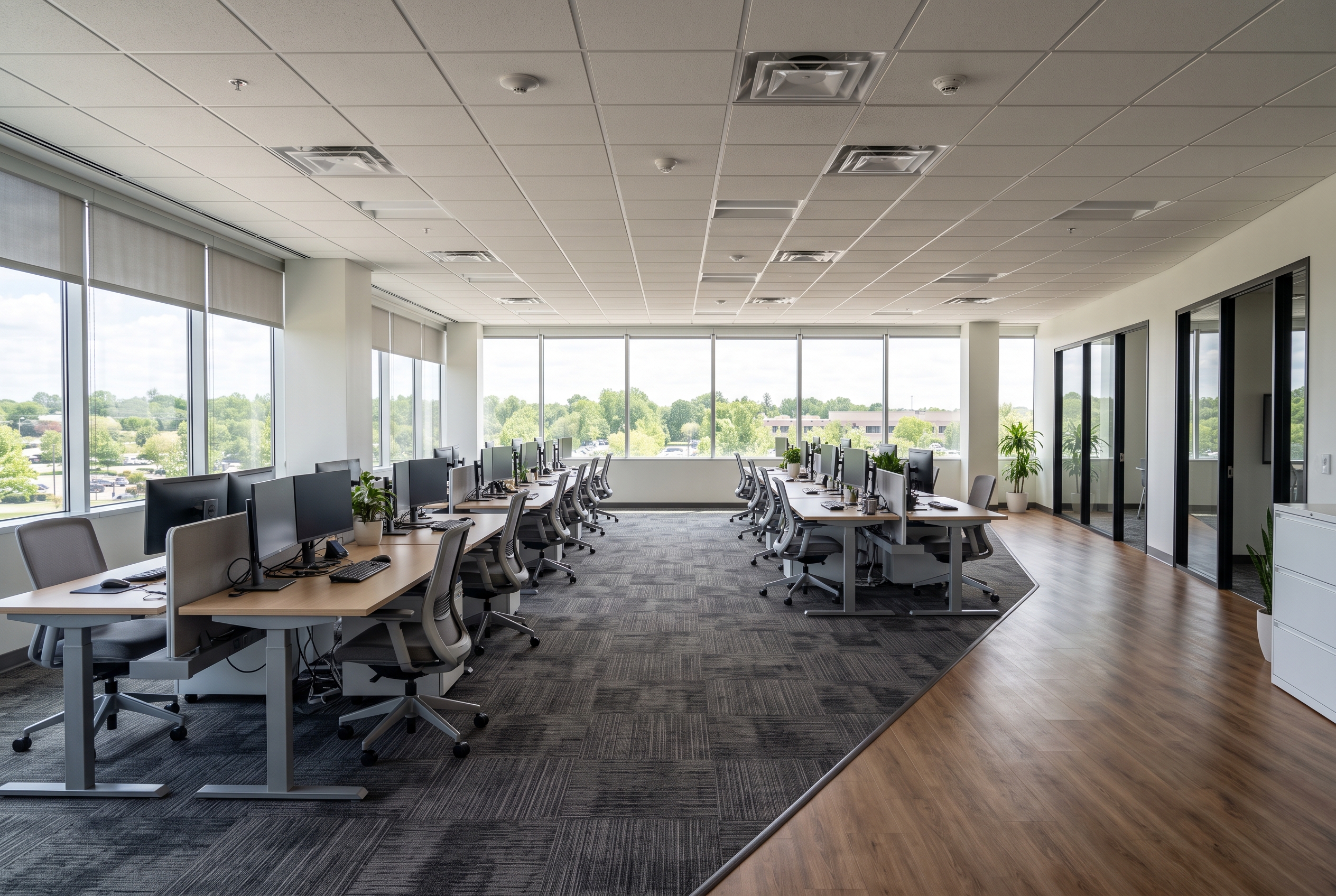
The best soundproof commercial floor is carpet tile, and any hard floor gets quieter with a resilient underlayment under it. Flooring controls two kinds of noise: footsteps and impacts that travel down to the space below, and the clatter of feet and chairs inside the room. The finish and what goes under it decide most of the first, while the ceiling does most of the work on echo.
Carpet tile is the quietest commercial floor for both jobs. It cushions footsteps before they reach the slab and soaks up sound in the room, most of all with a cushion back.
Luxury vinyl (LVT) is the durable, easy-clean choice, and its quiet comes from what sits under it. A built-in pad or a tested acoustic underlayment makes the difference.
Rubber flooring is the answer where impacts are heavy, like a fitness area. Thickness is what buys the quiet.
Wood, laminate and tile are the loudest finishes on their own. Wherever someone works underneath, they need a resilient layer or a floating system.
The right floor depends on the room, and this is the usual best choice for each.
| Space | Usual best choice | What makes it work |
|---|---|---|
| Open-plan office | Carpet tile | Cushion back, acoustic ceiling |
| Conference room or private office | Carpet tile | Walls built to the slab |
| Call center | Carpet tile | Cushion back, ceiling and masking |
| Classroom or library | Carpet tile, or LVT with a pad | Ceiling tile handles the echo |
| Corridor, lobby or retail floor | LVT on acoustic underlayment | A tested rating on your slab |
| Fitness area | Rubber | Thickness where weights land |
| Space above or below apartments | Any finish in a rated assembly | Code calls for STC and IIC 50 |
Why soundproofing matters in commercial spaces
Soundproofing matters in commercial spaces because noise is one of the most common complaints about any workplace, and acoustic problems rank near the top of what people dislike about their offices. In multi-story buildings, footsteps and rolling chairs overhead are the classic tenant complaint.
A floor handles only part of the problem. It controls footfall, chair and cart noise in the room, and the impact noise that reaches the space below. The acoustic ceiling is usually the biggest sound absorber in an office, and walls and sound masking handle speech privacy. Knowing which job belongs to the floor keeps you from paying for flooring to fix a ceiling problem.
Impact noise, airborne noise and the ratings on a spec sheet
Impact noise is the sound of something striking the floor: heels, dropped objects, chair legs. Airborne noise travels through the air, like voices and music. Each has its own rating, and these four numbers are the ones you will see on flooring spec sheets:
- IIC (Impact Insulation Class) rates how well a whole floor-ceiling assembly stops impact noise. Higher is better, and 50 is the usual point where the people below stop complaining.
- STC (Sound Transmission Class) rates how well the assembly blocks airborne sound. It tracks speech well but understates low sounds like fans, motors and bass.
- Delta IIC rates a floor covering or underlayment by itself: how many points it adds to a standard concrete slab. It is the fairest way to compare two products.
- NRC (Noise Reduction Coefficient) rates how much sound a surface absorbs, from 0 (none) to 1 (all). It describes noise in the room, not noise to the room below.
An IIC or STC number belongs to the whole assembly, so the same covering rates very differently on a concrete slab and on wood joists. Lab ratings also run higher than field ratings, and the standard test does not reproduce the low thump of someone walking. A light wood structure can earn a good score and still thump.
Building codes set sound numbers only where people live. The International Building Code, which the Michigan Building Code adopts with state amendments, calls for STC 50 and IIC 50 on floors between dwelling units, and between a dwelling and a public or service area. It accepts 45 when the finished building is tested in the field.
That covers a shop, office or restaurant above or below apartments, and the building department confirms what applies to your project. Offices and schools on their own have no floor sound minimum, so the target is yours to set.
Best soundproof flooring materials for commercial spaces
The best soundproof flooring materials are the soft, thick ones, and a hard finish only competes when something resilient sits under it. Research by Canada's National Research Council shows how wide the spread is, and how much the structure underneath matters.
Carpet and underlay rate far higher than any hard finish on either structure in these approximate IIC figures.
| Floor finish | On a 6-inch concrete slab | On a wood-joist floor |
|---|---|---|
| Ceramic tile | 28 | 40 |
| Hardwood | 33 | 47 |
| Vinyl | 37 | 47 |
| Thin wood on a 1/4-inch resilient layer | 47 | 47 |
| Carpet and underlay | 75 to 85 | 75 to 85 |
Carpet tile
Carpet tile is the quietest commercial floor for footfall and impact. Carpet with a good cushion rates far above the code line, and footsteps on carpeted concrete rarely bother anyone below. It absorbs sound in the room too: commercial loop carpet laid on concrete absorbs roughly 20 to 35 percent of the sound that strikes it, and a cushion underneath adds another 10 to 20 percentage points.
A few details make one carpet tile quieter than another. A cushion or foam back adds the most, for both impact and absorption. Cut pile absorbs more than loop pile of the same weight, and taller loops absorb more than shorter ones. Our carpet tile selection includes commercial lines from Aladdin Commercial and Pentz, and the modular format lets you replace a stained or worn tile without touching the rest.
Luxury vinyl (LVT)
Luxury vinyl is a thin layer, so on its own it stops less impact noise than carpet: bare vinyl on concrete adds about 9 points to the slab's rating. Its quiet comes from what sits under it. A built-in pad or a separate acoustic underlayment is what moves the number, and the tested rating for that exact product and underlayment tells you whether it reaches your target.
LVT earns its place where carpet struggles: lobbies, corridors, break rooms and retail floors that see spills and rolling carts. Many of the floors in our luxury vinyl collection have an underlayment built in, and we carry both glue-down and click-together versions. When you compare vinyl for sound, look for a published IIC or delta IIC rather than thickness alone.
Rubber flooring
Rubber flooring is one of the most effective materials against impact noise because it is resilient and it can be made thick. Foamed or shredded rubber is also one of the best layers to put under another floor, for the same reason. The quietest rubber floor for a multi-story building is the thickest, softest one that suits the use, placed where the impacts actually happen.
In a fitness area, match the rubber's thickness to the heaviest weights that will be dropped, following the rubber maker's guidance, and put the thickest material where they land. In clinics and school corridors, rubber is chosen as much for comfort and slip resistance as for sound.
Rubber flooring vs LVT for noise and durability
For noise alone, rubber usually beats LVT because it is thicker and more resilient. For most offices, retail floors and corridors, LVT is the more practical floor, and an acoustic underlayment is how it gets quieter. Choose rubber where heavy impacts are daily life, like a gym or weight room. Choose LVT where looks, easy cleaning and cost per square foot lead.
Cork
Cork works best as a resilient layer. A cork mat under wood, tile or vinyl is one of the most effective ways to raise the impact rating on concrete, and cork as a finished floor absorbs footfall better than hard finishes do.
Wood and laminate
Wood and laminate are hard surfaces, so they need help wherever someone works below. Hardwood glued straight to concrete is barely quieter than bare concrete, while the same wood over a resilient layer gains a lot. On wood joists, a thin pad under wood or laminate does little for the room below, and the gains come from added mass and a better ceiling.
Tile and stone
Tile and stone are the loudest finishes for the space below, and ceramic tile glued to a joist floor can even lower its rating. Over a sound mat rated for tile, they work in lobbies and restrooms. Our post on reducing noise with tile and stone covers sound mats under tile in more detail.
Is carpet on concrete quieter than wood between floors?
Yes, carpet on concrete stops far more noise between floors than wood, especially the sharp, high-pitched clicks of heels and chair legs. Carpet and underlay on a 6-inch slab rate an IIC of roughly 75 to 85, against about 33 for hardwood on the same slab. The carpet cushions each impact before it reaches the concrete, and its fibers absorb high-frequency sound in the room.
For offices stacked over offices, carpet tile on the slab is the simplest way to keep footsteps off the ceiling below. Where the design calls for wood, set it on a resilient layer instead of straight on the concrete.
Installation methods for soundproof commercial flooring
How a commercial floor is installed decides as much as what it is made of. The main tools are an acoustic underlayment, the right choice between floating and glue-down, a sound-control subfloor where the structure is light, and walls that stop at the slab.
Acoustic underlayment
An acoustic underlayment is a resilient layer of rubber, cork, foam or fiber placed between the subfloor and the finished floor. On concrete, it is the single most effective upgrade for a hard floor. Ask for the underlayment's delta IIC, and for the IIC of an assembly close to yours with your finished floor on top. A number tested on a different structure tells you little.
Underlayment under laminate or wood in an office
The underlayment that improves acoustics under laminate or wood in an office is a dense, tested acoustic underlayment, heavier than the thin foam used in homes. On a concrete floor, a rubber or cork underlayment with a published delta IIC makes the real difference. On a wood-framed floor, expect less from any pad and more from the ceiling below. For homes, our guide to underlayment options for laminate compares foam, cork, rubber and felt.
Floating floors and glue-down floors
A floating floor clicks together over an underlayment, and it isolates impact from the slab when that underlayment is resilient enough. A glue-down floor bonds to the subfloor, which feels solid and sounds quieter in the room itself, and it relies on the flooring and any acoustic layer under it for the room below. The right one depends on the building, the traffic and what is underneath.
Sound-control subfloors and floating slabs
A sound-control subfloor matters most on a light wood-framed structure, where only carpet and pad lifts the impact rating much on its own, and even then the low thump of footsteps comes through. Hard floors there need mass and a resilient layer. Each doubling of the weight of the subfloor and ceiling raises the IIC by about 7 points.
A concrete or gypsum topping adds that mass but makes the surface hard, so it needs a resilient layer beneath it or a soft finish on top. A floating slab, a rigid layer laid on a resilient mat, is the heavy-duty version.
Walls, edges and flanking noise
Sound takes the easiest path, and a wall built on top of the finished floor gives it one. A partition set on carpet lets sound slip underneath into the next office. Build demising walls to the slab and run the flooring up to them, and keep hard contact between a floating floor and the walls to a minimum.
The quietest floor for each kind of commercial space
The quietest floor for a commercial space depends on what happens in it and who works below it. These are the usual choices, and the reason for each.
Open-plan offices and call centers
Open-plan offices and call centers need carpet tile with a cushion back. Carpet is especially good at absorbing footfall, which is the floor's main job there, and an acoustic ceiling plus sound masking handles the voices.
Conference rooms, private offices and studios
Conference rooms, law offices, media rooms and editing suites need privacy as much as quiet. Carpet tile keeps chair and foot noise down, and walls that run to the slab keep conversations from traveling under them.
Classrooms and libraries
Classrooms and libraries do best with carpet tile or LVT on a pad, under an acoustical tile ceiling. Carpet does little for a classroom's echo, but it cuts the noise of sliding chairs and desks. The Acoustical Society of America finds that an acoustical ceiling alone often brings a classroom into its recommended range. That range is a reverberation time of about 0.4 to 0.6 seconds, with background noise no higher than 35 dBA.
Corridors, lobbies and retail floors
Corridors, lobbies and retail floors take carts, spills and street grit, so LVT is usually the working choice. Put it on a tested acoustic underlayment wherever there is occupied space below, and use walk-off carpet at the entrances to catch grit and slush.
Healthcare, event venues and fitness areas
Healthcare spaces lean on resilient floors that clean easily, with acoustic underlayment where rooms stack. Event venues usually split the floor: carpet tile in meeting rooms, LVT on underlayment in circulation areas. Fitness areas need rubber, thickest where weights drop.
Commercial space near apartments
Commercial space above or below apartments has to meet STC 50 and IIC 50 for the whole floor-ceiling assembly. The finish is one part of that, so the tested assembly, not the product brochure, is what the building official reviews. For choices by industry beyond sound, see our guide to choosing commercial flooring for your industry.
How to compare acoustic flooring from any manufacturer
The best acoustic flooring is the product with published, comparable test data for your structure, whoever makes it. Every major maker sells acoustic lines, so judge them the same way:
- Delta IIC on a concrete slab, to compare coverings and underlayments with each other.
- IIC and STC for a complete assembly close to yours, with the exact underlayment.
- NRC, if noise in the room matters, as in an open office.
- A test report from an independent acoustical lab that names the standard.
- Lab numbers treated as the best case; the finished building will measure a little lower.
Long-term cost follows the same practical logic. Modular floors, carpet tile and LVT planks, let you replace a worn or stained piece instead of a room, which keeps an acoustic floor in service longer. Walk-off mats at the doors keep grit from wearing it out early.
Who installs commercial sound-control flooring
At Floor4Life, we handle commercial installations in-house, from small offices to large-scale projects, across Sterling Heights, Metro Detroit and the rest of Michigan. For a sound-control floor, that means the finished floor and the acoustic underlayment under it, chosen for your structure and installed together. We can bring samples to you, and our flooring services list the rest of what we do.
Some parts of a quiet building belong to other trades. A concrete or gypsum topping, a resiliently hung ceiling below, demising walls, acoustic ceiling tile and sound masking come from your general contractor or acoustical consultant. If you are planning a build-out, bring the floor into the plan early so the underlayment, the walls and the finished floor fit together.
The cost of a sound-control floor depends on the square footage, the finish and underlayment, and how much slab or subfloor prep the space needs. Floating versus glue-down matters too, as does whether the work has to happen around your business hours. We price it at a free estimate, after we see the space and what is below it. Our family-owned team has been installing floors for more than 25 years.
Questions about commercial floor soundproofing
Can you soundproof an existing commercial floor without tearing it out?
Partly, because the biggest gain comes from a resilient layer under the finish, which means replacing the finished floor. Short of that, carpet tile or large rugs in the noisiest areas cut footfall, and a resiliently hung ceiling in the space below can raise the impact rating without touching the floor at all.
Does soundproof flooring stop noise from the floor below?
No, not much. Flooring mainly controls impact noise traveling down. Voices, music and equipment noise coming up from below are airborne sound, and blocking them depends on the mass and airtightness of the whole floor-ceiling assembly, which is a structure and ceiling job.
Is a thicker underlayment always better?
Not always, though more thickness usually raises the impact rating. The right underlayment is the one tested with your finished floor. Click-together vinyl and laminate also have limits on how soft and thick the layer under them can be, and going past them can stress the joints.
Plan a quieter floor
If footsteps, chairs or echo are costing you tenants or focus, the fix starts with knowing which noise you have and what is under your floor. Request a free estimate, and we will look at your space, the structure below it and the traffic it sees, then recommend the floor and underlayment that fit.